
A Note from Michael Gossett | August 14, 2026
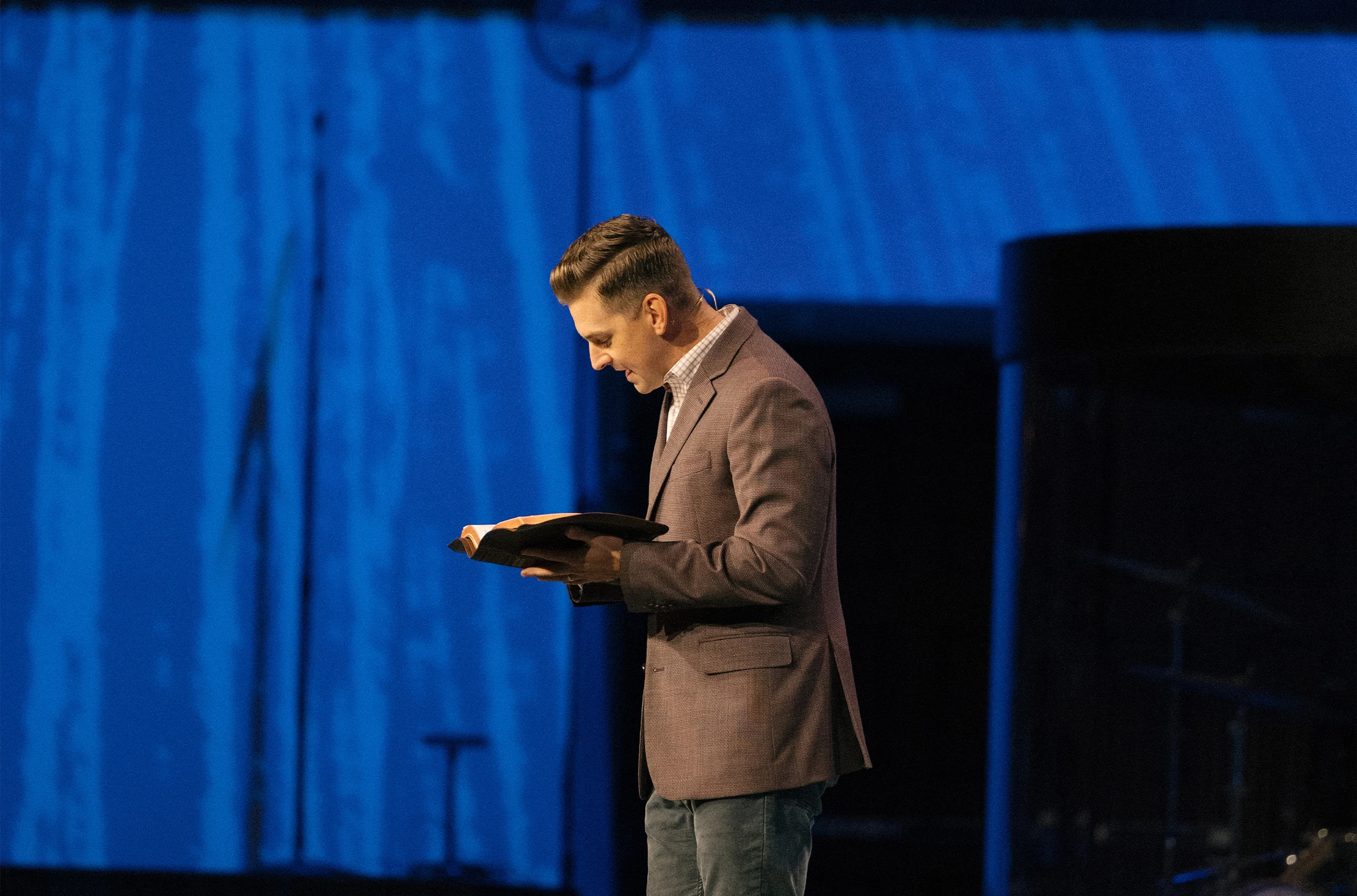
A Healthy Church:
A Church Built on the Word
I want to say, thank you! For the last six weeks, I have been away on sabbatical, and that time was a gift, one that you gave me. I know that a season away like this is a tremendous blessing and a huge undertaking. It requires significant effort, coordination,and additional work from our staff and leaders, who already have a full load. But what is incredible is that every one of you allowed this to take place with joy and without any complaint. What a gift you are!
These weeks were really encouraging and good for my own soul. I had unhurried time with the Lord, ordinary and unrushed days with my family, and space to rest, plan, pray, and dream in ways that ordinary demands of ministry rarely allow. I am returning with a full heart of gratitude and a renewed focus on what matters most in ministry for my family and the Lord’s church. A healthy church is never held up by one pastor, one staff member, or one church member. It is held up by the Word of God at work in an entire people.
Building on the Foundation
If you have ever built anything, you know the importance of how you begin. Where you start will determine the course of how you will build. This is absolutely true of building a house. Long before the framing goes up, before the roofline takes shape and the neighbors even begin to notice, there is a crew standing in a hole in the ground. They are not building anything you can see. They are pouring a foundation. It is slow, and really uneventful work. When the work is done, it will even be buried and forgotten by nearly every person who ever walks through the front door. Yet every wall, every window, and every roof beam that will ever be raised depends entirely on that first concrete job.
The church is like this. A congregation can look strong from the street, the parking lot can be full, the music can be excellent, the energy can be felt, and yet the foundation can and will determine whether or not that church really stands in the way she should. There is only one foundation that holds. It is not a personality, a program, people, a budget, or a brand. The health of a church rises or falls on its relationship and commitment to the Word of God. Everything else is framing. This is where we have to begin, because if we get this wrong, then nothing else we build together will ever stand.
Paul knew this for certain. As he came to the end of his life, writing from a Roman prison to a young pastor named Timothy who was leading a church in a hostile city, he did not leave Timothy with a strategy for growth or a plan for programs. He left him with the Word.
Paul writes this in 2 Timothy 3:14-17:
“But as for you, continue in what you have learned and firmly believed. You know those who taught you, and you know that from infancy you have known the sacred Scriptures, which are able to give you wisdom for salvation through faith in Christ Jesus. All Scripture is inspired by God and is profitable for teaching, for rebuking, for correcting, for training in righteousness, so that the man of God may be complete, equipped for every good work.”
In only four verses, Paul lays the foundation of a healthy church. He tells us to hold on to the Word, he tells us why the Word can be trusted, he tells us what the Word does in us, and he tells us where the Word is taking us.
A Healthy Church Continues in the Word
Notice the very first words Paul gives to Timothy. “But as for you, continue in what you have learned and firmly believed.” The little phrase, “but as for you” carries a lot of weight and makes this very personal. In the verses just before this, Paul has described a world drifting badly. He has spoken of people who are lovers of self and lovers of money, of a culture that has a form of godliness but denies its power, of deceivers going from bad to worse. And then, against all of that, Paul turns to Timothy and says, but you are to be different. You are to continue and remain steadfast in the Word.
The word translated continue carries the idea of remaining, of abiding, of staying put when everything around you is moving. It is not the language of a sprint but of a settled home. The instinct of a healthy church, when the culture shifts and the pressure rises, is not to go looking for something new. It is to remain in what is old and tested and true. A drifting church is always chasing the next thing. A healthy church stays anchored to the same Word it has always has.
And Paul gives Timothy two reasons he can continue with confidence. First, he says, “you know those who taught you.” Timothy had watched faithful people live out the truth in front of him, his mother Eunice and his grandmother Lois among them. The Word hadnot come to him as cold or distant information. It had come to him through people whose lives made it believable. This is one of the more subtle marks of a healthy church. The Word is not only preached from a pulpit. It is carried in the lives of ordinary saints who make it credible to the next generation. Second, Paul says Timothy has known “from infancy the sacred Scriptures, which are able to give you wisdom for salvation through faith in Christ Jesus.” Here is the aim of the whole Bible. The Scriptures do not exist to make us clever. They exist to make us wise unto salvation, and that wisdom is found in one place, in faith in Christ Jesus. The Word is not an end in itself. It is the road that leads to the Savior. A church that loves the Bible but does not arrive at Christ has missed the point of the bible entirely. We do not gather around a book for the book’s sake. We gather around a book because on every page it is pointing us to a person, and that person is Jesus.
A Healthy Church Trusts the Word Because It Is God-Breathed
Then Paul makes a statement that is the bedrock beneath everything else. “All Scripture is inspired by God.” Behind that phrase stands a single, remarkable Greek word, theopneustos. It is built from two words, one meaning God and one meaning breath, and so the plainest translation is that Scripture is God-breathed. Paul is not saying the Bible is inspiring in the way a sunset or a symphony inspires us. He is saying it came out of the very mouth of God. The words on the page carry the breath of God the way your words carry your breath when you speak.
This should change everything about how a church treats its Bible. If the Scriptures are merely the best religious thinking of ancient men, then we are free to weigh them, edit them, and set aside the parts we look at as inconvenient. But if they are breathed out by God, then to hear them is to hear Him, and to obey them is to obey Him, and to argue with them is to argue with Him. The old pastors used to say the same breath of God that gave the Scriptures their life is the breath that gives our souls life when we receive them. That is why a healthy church does not stand over the Word as its judge. It sits under the Word as its servant.
Notice the word Paul uses for what the Scriptures are. He calls them profitable. The Greek word means useful, beneficial, and good for us. This is such a pastoral word from Paul. Paul does not say the Bible is merely true, though it is. He says it is good for you. It is not a burden laid on the church to weigh us down. It is a gift given to the church to build us up. When a congregation begins to feel the Word as a set of restrictions to be tolerated, something has gone wrong at the foundation. A healthy church has tasted that the Word is profitable, that it is sweet, that as one Puritan writer put it, the Scriptures are a physician’s cabinet stocked with a cure for every disease of the soul. We do not open the bible in the way we open a rulebook. We open it in the way a hungry person opens the door to a feast.
A Healthy Church Is Shaped by the Word
Paul does not leave us to wonder how the Word is profitable. He tells us with four specific words, and together they trace the whole arc of how God changes a person. The Scripture, he says, is profitable “for teaching, for rebuking, for correcting, for training in righteousness.”
It begins with teaching. This is the positive laying down of truth, the doctrine that tells us who God is, who we are, what he has done in Christ, and how we are to live. Before the Word can correct us, it must first inform us. A healthy church is a taught church. It is a place where the whole counsel of God is opened patiently, week after week, book after book, until the people of God actually know their God and are not blown around by every new idea that comes along.
Then comes rebuking. This is the part that we often forget or at least want to forget about the gift of God’s Word. This is the harder edge of the Word, the moment when Scripture tells us we are wrong. There are things we believe that are false and things we do that are sinful, and a faithful Bible will not flatter us about either one. This is where many churches lose their nerve. It is much easier to comfort than to confront. But a word that can only affirm us and never rebuke us is not the God-breathed Word at all. A healthy church loves its people enough to let the Bible tell them the truth, even when the truth stings.
Yet the Word never rebukes in order to leave us in the dirt. Paul moves immediately to correcting. The word here has the sense of setting something upright again, of restoring what has fallen, of putting a thing back in its proper place. This is the mercy of God written into the very purpose of Scripture. The Bible does not knock us down and walk away. It knocks us down and then reaches for our hand and lifts us back to our feet. John Owen, and the older writers, understood that conviction of sin is never God’s final word to His children. It is His first word, and the last word is always restoration.
“Training in righteousness.” The word for training is a word drawn from the raising of a child, the long, daily, patient work of discipline and formation that shapes a life over years. This is the slow work, and it is the work most churches are tempted to skip. We want the crisis moment, the powerful service, the decision made in a single night. God gives us those, but he does most of His work the way a parent raises a child, one ordinary day at a time. A healthy church is not built on spiritual highs. It is built on the steady, unhurried training of God’s people in righteousness, until the shape of Christ begins to appear in ordinary lives.
Do you see the movement in these four words? The Word teaches us what is true, rebukes us where we are wrong, corrects us and sets us back on our feet, and then trains us over a lifetime into the likeness of Christ. This is the full ministry of the Word in a healthy church, and you cannot take one of these and leave the rest. A church that only teaches becomes proud. A church that only rebukes becomes harsh. A church that never rebukes becomes soft. But a church that lets the whole Word do its whole work becomes healthy.
A Healthy Church Is Equipped by the Word for Every Good Work
Finally, Paul tells us where all of this is going. The Scripture does its work “so that the man of God may be complete, equipped for every good work.” There is a purpose behind the teaching and the rebuking and the correcting and the training, and here it is. God is making His people complete.
This means that the Lord Himself is making His people whole, fitted together, having all the parts that a thing is supposed to have. Then, he adds a second word, equipped, which comes from the picture of a ship being fully outfitted before it sets sail or a craftsman being fully supplied before he begins his work. Nothing is missing. Nothing is lacking. The Word of God is sufficient to take a person and make them whole and hand them everything they need for the work God has for them.
Paul does not say the Scriptures make us complete so that we can sit still and admire how complete we are. He says we are equipped “for every good work.” The Word is not given to fill our heads. It is given to send our hands. A healthy church that continues in the Word, that trusts the Word, that is shaped by the Word, is a church that is then thrown outward into the world to do the good works God prepared for it. The Bible is not a pool for us to soak in, but a river that carries us out to the harvest.
This is the foundation. All of this, the continuing, the trusting, the shaping, the sending, rests on one conviction, that this Word is God-breathed and therefore sufficient. We do not need to add to it, and we cannot afford to subtract from it. A church built on anything else may stand for a season, but when the storms come, and they always come, only the church built on the Word of God will still be standing. Let us be that church. Let us pour this foundation deep, and let us build the rest of our life together upon it. This is the foundation for your life, your marriage, your family, your parenting, your Connect Group, and our entire church.

This coming Sunday is a special one that you don’t want to miss! It is Vision Sunday, and I am excited to be back in the pulpit. I can’t express how much I have missed standing before you with an open Bible. We will get back into the Gospel of Luke as we continue our series together. Luke 14:1-24 is a passage that begins at a dinner table and opens up into a portrait of the Kingdom of God, and it ends with one of the most compelling images in all of Scripture. A master prepares a great banquet, and when the invited guests make their excuses, he sends his servant out into the streets and the roads to bring in the poor and the crippled and the outsider, because he will not rest until his house is full. This is God’s vision for His Kingdom and His vision for our church. God’s heart is not for a half-empty house. It is for a full table, crowded with people who once believed they would never be welcome. As we launch this series on a healthy church, that is the vision I want us to carry from the very first Sunday, a church built on the Word of God and driven by the same holy longing that fills the Master’s house. I cannot wait to open this passage with you. See you this Sunday!
You are loved and prayed for!
Michael Gossett